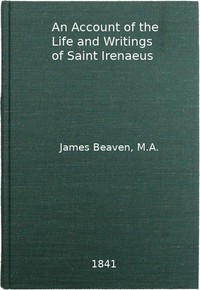
An Account of the Life and Writings of S. Irenæus, Bishop of Lyons and Martyr

(4 User reviews)   1329
By Abil Kile Posted on Nov 15, 2025
In Category - Romance
Beaven, James, 1801-1875 Beaven, James, 1801-1875
English
Ever wonder about the guy who helped decide what books belong in the Bible? This book is about him. Irenaeus was a second-century bishop who fought against wild religious ideas that threatened to tear Christianity apart before it even got started. James Beaven’s biography isn’t just a dusty history lesson—it’s the story of a man standing in the chaos, trying to hold everything together. If you like stories about forgotten heroes who shaped the world from the ground up, you’ll be hooked by this account of faith, conflict, and one man's quiet determination.
Share

Read "An Account of the Life and Writings of S. Irenæus, Bishop of Lyons and Martyr" Online

This book is available in the public domain. Start reading the digital edition below.

START READING FULL BOOK
Instant Access    Mobile Friendly

Book Preview

A short preview of the book’s content is shown below to give you an idea of its style and themes.

Tenets and Practices of the Gnostic Heretics, During the Second Century. By James Beaven, M.A. Of St. Edmund Hall, Oxford And Curate of Leigh, in the County of Stafford. London: J. G. F. & J. Rivington 1841 CONTENTS Preface. Subscribers’ Names. Chapter I. Life of S. Irenæus, and General Account Of His Writings. Chapter II. Testimony of Irenæus to Certain Facts of Church History. Chapter III. On The Nature, Office, Powers, and Privileges Of The Church. Chapter IV. On The Doctrine of the Holy Trinity. Chapter V. The Origin of Evil. Chapter VI. The Evil Spirits. Chapter VII. The Divine Dispensations. Chapter VIII. On The Canon, Genuineness, Versions, Use, And Value Of Holy Scripture. Chapter IX. On The Nature And Use of Primitive Tradition. Chapter X. On The Creed. Chapter XI. Freewill, Predestination, And Election. Chapter XII. On Baptism. Chapter XIII. The Eucharist. Chapter XIV. On Justification. Chapter XV. On Ceremonies, Usages, And Forms Of Words. Chapter XVI. On The Sabbath. Chapter XVII. On The Typical Interpretation Of Scripture. Chapter XVIII. On The Intermediate State. Chapter XIX. On Unfulfilled Prophecy. Chapter XX. The Virgin Mary. Chapter XXI. Account of the Gnostic Teachers and Their Tenets. Section I. Simon Magus, Nicolas, and the Ebionites. Section II. Menander, Saturninus, And Basilides. Section III. Carpocrates And Cerinthus. Section IV. Cerdon, Marcion, Tatian, And The Cainites. Section V. The Barbeliots, Ophites, And Sethites. Section VI. Valentinus. Section VII. Secundus, Epiphanes, Ptolemy, Colorbasus, And Marcus. Section VIII. Gnostic Redemption. Section IX. Reflections Upon Gnosticism. Footnotes [Cover Art] [Transcriber’s Note: The above cover image was produced by the submitter at Distributed Proofreaders, and is being placed into the public domain.] DEDICATION. To the Memory Of Edward Burton, D.D. Late Regius Professor Of Divinity In The University Of Oxford, By Whose Advice And Encouragement The Author Of This Work Was First Led To Study, With Care And Attention, The Writings Of This Father and Martyr. It Is Now Dedicated And Inscribed; As A Humble Acknowledgement Of His Extensive Learning, His Remarkable Singleness Of Mind, And The Cordial Assistance He Ever Rendered To Younger Travellers In The Same Path Which He Himself Pursued. PREFACE. It was, perhaps, somewhat presumptuous in a person occupying so humble a station in the sacred ministry to offer to the Church a work which would necessarily induce comparisons between itself and the similar productions of a Prelate of the Church—a Divine of the highest rank and character. The author can, however, at least say, that it was no foolish ambition which led to his employing himself on such a work. Having been led by circumstances to a repeated perusal and study of the writings of S. Irenæus, he saw the great value of his testimony to the leading principles and doctrines of the Church of England. He had himself derived much benefit from the works of Bishop Kaye on others of the Fathers; he thought that if he could do nothing more than to draw out the substance of the doctrine and opinions of Irenæus for the use of the student in theology, in a more accessible form than that in which he himself had to look for it, accompanied by the text of the portions from which he had formed his statements, and with a little illustration of the meaning in passages liable to misunderstanding,—he should have rendered a service to his younger brethren: and if it should so happen that that distinguished Prelate or any other writer did anticipate him, it would be so much clear gain to himself to have been so employed. When he had completed his first preparations,...

This is a limited preview. Download the book to read the full content.

The Story

This book follows Irenaeus, a Greek man who became a bishop in Roman-occupied France (then called Lugdunum, now Lyon) in the late 100s AD. It was a crazy time. Christianity was new, scattered, and full of competing, often bizarre, interpretations. Irenaeus’s main fight was against Gnosticism, a popular set of beliefs that claimed secret knowledge and saw the physical world as evil. The book shows how he traveled, wrote letters, and argued passionately for a simpler, unified faith based on the teachings passed down from Jesus’s apostles.

It’s also the story of a community under pressure. Irenaeus witnessed brutal persecution, including the martyrdom of his own bishop. The book places him right in the middle of this tension, showing how he led not just with words, but by example.

Why You Should Read It

I went in expecting a dry church history, but found a genuinely human story. Beaven makes Irenaeus feel real—not a stained-glass saint, but a pastor trying to keep his flock from spiraling into confusion. You see his frustration with fancy, abstract theories that ignored helping real people. His big idea was stunningly simple for the time: there is one God who created the good world, and faith should be open to everyone, not just an elite few with ‘secret knowledge.’ It’s a fight for clarity and inclusion that still echoes today.

Final Verdict

Perfect for history buffs who enjoy niche, foundational stories, or anyone curious about how early Christian beliefs were formed. It’s not a light beach read, but Beaven’s writing is clear and driven by obvious admiration for his subject. You’ll come away with a real appreciation for one of history’s most influential quiet thinkers—the kind of guy whose work shaped centuries, but whose name most of us never learned.


🟢 Public Domain Content

This work has been identified as being free of known copyright restrictions. Share knowledge freely with the world.

Karen Harris
1 year ago

High quality edition, very readable.

Oliver Jones
1 year ago

Comprehensive and well-researched.

John Jackson
4 months ago

I have to admit, the plot twists are genuinely surprising. One of the best books I've read this year.

Kimberly Harris
6 months ago

I started reading out of curiosity and the narrative structure is incredibly compelling. Absolutely essential reading.
4
4 out of 5 (4 User reviews )

Add a Review

Your Rating *
There are no comments for this eBook.
You must log in to post a comment.
Log in


Related eBooks