
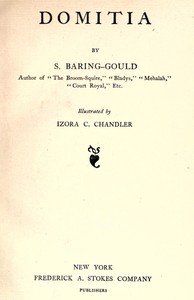
Domitia by S. Baring-Gould

(0 User reviews)   531
By Abil Kile Posted on Nov 15, 2025
In Category - History
Baring-Gould, S. (Sabine), 1834-1924 Baring-Gould, S. (Sabine), 1834-1924
English
Okay, picture this: ancient Rome at its most decadent and dangerous. Now, drop a clever, observant woman right into the middle of the imperial court's worst scandals. That's 'Domitia'. This isn't just a dry history lesson; it's a personal, ground-level view of power, survival, and loyalty. The book follows Domitia Longina, who becomes Empress, as she navigates a world where her husband, Emperor Domitian, grows increasingly paranoid and cruel. The real hook? You're seeing history unfold through the eyes of someone who was there, caught between duty, fear, and her own conscience. If you like historical fiction that feels immediate and human, rather than just a list of dates and battles, you need to pick this up.
Share

Read "Domitia by S. Baring-Gould" Online

This book is available in the public domain. Start reading the digital edition below.

START READING FULL BOOK
Instant Access    Mobile Friendly

Book Preview

A short preview of the book’s content is shown below to give you an idea of its style and themes.

Author of “The Broom-Squire,” “Bladys,” “Mehalah,” “Court Royal,” Etc. _Illustrated by_ IZORA C. CHANDLER NEW YORK FREDERICK A. STOKES COMPANY PUBLISHERS _Copyright, 1898_, BY FREDERICK A. STOKES COMPANY. _All rights reserved._ PRESSWORK BY THE UNIVERSITY PRESS, CAMBRIDGE, U.S.A. CONTENTS Book I I. The Port of Cenchræa II. An Ill-Omen III. Corbulo IV. There Is No Star V. The Ship of the Dead VI. I Do Not Know VII. The Face of the Dead VIII. The Sword of the Dead IX. Sheathed X. Ubi Felicitas? XI. The Veils of Ishtar XII. The Fall of the Veils XIII. To Rome! XIV. A Little Supper XV. The Lectisternium XVI. In the House of the Actor XVII. The Saturnalia of 69 XVIII. A Refugee XIX. The End of Vitellius XX. Changed Tactics XXI. The Virgin’s Wreath XXII. Quoniam Tu Caius, Ego Caia! XXIII. The End of the Day XXIV. Albanum XXV. By a Razor XXVI. Intermezzo Book II I. An Appeal II. The Fish III. In the ‘Insula’ IV. Another Appeal V. Atrium Vestæ VI. For the People VII. ‘The Blues Have It!’ VIII. The Lower Stool IX. Glyceria X. The Accursed Field XI. Again: The Sword of Corbulo XII. The Tablets XIII. The Hour of Twelve XIV. In the Tullianum XV. Drawing to the Light XVI. An Ecstasy XVII. Hail, Gladsome Light! Footnotes Transcriber’s Note DOMITIA. BOOK I. CHAPTER I. THE PORT OF CENCHRÆA. Flashes as of lightning shot from each side of a galley as she was being rowed into port. She was a bireme, that is to say, had two tiers of oars; and as simultaneously the double sets were lifted, held for a moment suspended, wet with brine, feathered, and again dipped, every single blade gleamed, reflecting the declining western sun, and together formed a flash from each side of the vessel of a sheaf of rays. The bireme was approaching the entrance to the harbor of Cenchræa. The one white sail was filled with what little wind breathed, and it shone against a sapphire sea like a moon. Now, at a signal the oars ceased to plunge. The sail was furled, and the galley was carried into the harbor between the temple that stood on the northern horn of the mole, and the great brazen statue of Poseidon that occupied a rock in the midst of the entrance, driven forward by the impulse already given her by the muscles of the rowers and the east wind in the sail. This Cenchræan harbor into which she swept was one of the busiest in the world. Through it as through a tidal sluice rushed the current of trade from the East to the West, and from the Occident to the Orient. It was planted on a bay of the Saronic Gulf, and on the Isthmus of Corinth, at the foot of that lovely range of mountains thrown up by the hand of God to wall off the Peloponnesus as the shrine of intellectual culture and the sanctuary of Liberty. And a furrow—like an artificial dyke—ran between this range and Hellas proper, a furrow nearly wholly invaded by the sea, but still leaving a strip of land, the Corinthian isthmus, to form a barrier between the Eastern and the Western worlds. On the platform at the head of a flight of marble steps before a temple of Poseidon, in her open litter, lounged a lady, with the bloom of youth gone from her face, but artificially restored. She was handsome, with finely moulded features and a delicate white hand, the fingers studded with rings, and a beautiful arm which was exposed whenever...

This is a limited preview. Download the book to read the full content.

Ever wondered what it was really like to live in the shadow of a Roman emperor? S. Baring-Gould's 'Domitia' gives us a front-row seat to one of history's most turbulent courts.

The Story

The novel follows Domitia Longina, a noblewoman who marries the future Emperor Domitian. We see her life unfold from a young bride to the Empress of Rome. But her husband's rule is marked by suspicion and brutality. Domitia finds herself in an impossible position: she is the emperor's wife, witnessing his dark descent, yet she's also a potential target of his paranoia. The story is her struggle to maintain her integrity and survive in a palace where whispers can be deadly and loyalty is a fragile thing.

Why You Should Read It

Baring-Gould makes ancient Rome feel startlingly familiar. Domitia isn't a statue on a pedestal; she's a fully realized person. You feel her quiet intelligence, her mounting dread, and her difficult choices. The book is less about grand battles and more about the psychological warfare of living with absolute power. It's a gripping study of a marriage trapped by politics and fear.

Final Verdict

This is a perfect pick for readers who love character-driven historical fiction. If you enjoy novels that explore the human side of famous figures and the tense, intimate drama of court life over sweeping military epics, you'll be captivated. Just be prepared—the Rome in these pages is claustrophobic, glittering, and deeply unsettling.


📚 Public Domain Content

There are no legal restrictions on this material. Preserving history for future generations.

There are no reviews for this eBook.

0
0 out of 5 (0 User reviews )

Add a Review

Your Rating *
There are no comments for this eBook.
You must log in to post a comment.
Log in


Related eBooks