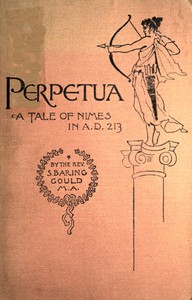
Perpetua. A Tale of Nimes in A.D. 213 by S. Baring-Gould

(6 User reviews)   2630
By Abil Kile Posted on Nov 15, 2025
In Category - Romance
Baring-Gould, S. (Sabine), 1834-1924 Baring-Gould, S. (Sabine), 1834-1924
English
Ever wonder what it felt like to be a Christian in the Roman Empire when that could get you killed? That's the heart of 'Perpetua: A Tale of Nimes in A.D. 213.' Sabine Baring-Gould drops us into the dusty streets of ancient France, where a young woman named Perpetua faces an impossible choice. Her new faith puts her at odds with her family, her culture, and the all-powerful Roman state. This isn't just a dusty history lesson; it's a tense, personal story about conviction, courage, and the cost of standing up for what you believe. Think of it as a gripping historical drama, but one that really happened.
Share

Read "Perpetua. A Tale of Nimes in A.D. 213 by S. Baring-Gould" Online

This book is available in the public domain. Start reading the digital edition below.

START READING FULL BOOK
Instant Access    Mobile Friendly

Book Preview

A short preview of the book’s content is shown below to give you an idea of its style and themes.

Southern France, whose fringe is kissed by the blue Mediterranean. Not a cloud in the nemophyla‐blue sky. The sun streamed down, with a heat that was unabsorbed, and with rays unshorn by any intervenient vapor, as in our northern clime. Yet a cool air from the distant snowy Alps touched, as with the kiss of a vestal, every heated brow, and refreshed it. The Alps, though invisible from Nemausus, make themselves felt, now in refreshing breezes, then as raging icy blasts. The anemones were in bloom, and the roses were budding. Tulips spangled the vineyards, and under the olives and in the most arid soil, there appeared the grape hyacinth and the star of Bethlehem. At the back of the white city stands a rock, the extreme limit of a spur of the Cebennæ, forming an amphitheatre, the stones scrambled over by blue and white periwinkle, and the crags heavy with syringa and flowering thorns. In the midst of this circus of rock welled up a river of transparent bottle‐green water, that filled a reservoir, in which circled white swans. On account of the incessant agitation of the water, that rose in bells, and broke in rhythmic waves against the containing breastwork, neither were the swans mirrored in the surface, nor did the white temple of Nemausus reflect its peristyle of channeled pillars in the green flood. This temple occupied one side of the basin; on the other, a little removed, were the baths, named after Augustus, to which some of the water was conducted, after it had passed beyond the precinct within which it was regarded as sacred. It would be hard to find a more beautiful scene, or see such a gay gathering as that assembled near the Holy Fountain on this first day of March. Hardly less white than the swans that dreamily swam in spirals, was the balustrade of limestone that surrounded the sheet of heaving water. At intervals on this breasting stood pedestals, each supporting a statue in Carrara marble. Here was Diana in buskins, holding a bow in her hand, in the attitude of running, her right hand turned to draw an arrow from the quiver at her back. There was the Gallic god Camulus, in harness, holding up a six‐rayed wheel, all gilt, to signify the sun. There was a nymph pouring water from her urn; again appeared Diana contemplating her favorite flower, the white poppy. But in the place of honor, in the midst of the public walk before the fountain, surrounded by acacias and pink‐blossomed Judas trees, stood the god Nemausus, who was at once the presiding deity over the fountain, and the reputed founder of the city. He was represented as a youth, of graceful form, almost feminine, and though he bore some military insignia, yet seemed too girl‐like and timid to appear in war. The fountain had, in very truth, created the city. This marvelous upheaval of a limpid river out of the heart of the earth had early attracted settlers to it, who had built their rude cabins beside the stream and who paid to the fountain divine honors. Around it they set up a circle of rude stones, and called the place _Nemet_—that is to say, the Sacred Place. After a while came Greek settlers, and they introduced a new civilization and new ideas. They at once erected an image of the deity of the fountain, and called this deity Nemausios. The spring had been female to the Gaulish occupants of the settlement; it now became male, but in its aspect the deity still bore indications of...

This is a limited preview. Download the book to read the full content.

Sabine Baring-Gould, a 19th-century writer and scholar, brings a forgotten corner of history to vivid life. He takes us to Nîmes in Roman Gaul, a place of sun-baked stone and simmering tension between old gods and a new religion.

The Story

The book follows Perpetua, a young woman from a respected family who converts to Christianity. In the year 213, this isn't a private spiritual choice—it's a public act of defiance. The Roman authorities demand that all citizens make a simple sacrifice to the emperor as a sign of loyalty. For Perpetua and her fellow believers, this act violates their faith. The story charts her journey from a quiet believer to a prisoner facing a terrible sentence, exploring the immense pressure from her heartbroken father, the Roman officials, and her own fears.

Why You Should Read It

What grabbed me was how human it all feels. Perpetua isn't a marble statue of a saint; she's a real person wrestling with doubt, love for her family, and sheer terror. Baring-Gould makes the ancient world feel immediate. You can almost smell the marketplaces and feel the cold of the prison. The central question—what would you sacrifice for your beliefs?—is timeless and packs a real emotional punch.

Final Verdict

This is a perfect pick for readers who love character-driven historical fiction that makes you think. If you enjoyed the personal stakes in books like The Last of the Wine or the early-church setting of Quo Vadis, you'll find a lot to love here. It's a short, powerful novel about courage that feels surprisingly relevant, reminding us that some choices define a life.


ℹ️ License Information

This content is free to share and distribute. You are welcome to share this with anyone.

Joshua Harris
9 months ago

Based on the summary, I decided to read it and the storytelling feels authentic and emotionally grounded. Truly inspiring.

Charles Gonzalez
7 months ago

I started reading out of curiosity and the author's voice is distinct and makes complex topics easy to digest. I will read more from this author.

Kevin Clark
1 year ago

Five stars!

Linda Allen
1 year ago

A must-have for anyone studying this subject.

Mason Nguyen
1 year ago

Perfect.

4.5
4.5 out of 5 (6 User reviews )

Add a Review

Your Rating *
There are no comments for this eBook.
You must log in to post a comment.
Log in


Related eBooks