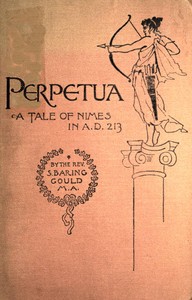
Perpetua. A Tale of Nimes in A.D. 213 by S. Baring-Gould

(3 User reviews)   1976
By Abil Kile Posted on Nov 15, 2025
In Category - History
Baring-Gould, S. (Sabine), 1834-1924 Baring-Gould, S. (Sabine), 1834-1924
English
I just finished a book that took me somewhere I've never been before. It's called 'Perpetua: A Tale of Nîmes in A.D. 213.' Forget knights and castles—this is ancient Gaul, right after the Roman Empire took over. The story follows a young woman, Perpetua, caught between the old Celtic gods her people worshipped for centuries and the new Christian faith that's starting to spread. It's not just about religion; it's about family, loyalty, and what you're willing to sacrifice when your whole world is changing. If you like historical fiction that feels real and characters you can actually root for, you need to pick this up.
Share

Read "Perpetua. A Tale of Nimes in A.D. 213 by S. Baring-Gould" Online

This book is available in the public domain. Start reading the digital edition below.

START READING FULL BOOK
Instant Access    Mobile Friendly

Book Preview

A short preview of the book’s content is shown below to give you an idea of its style and themes.

Southern France, whose fringe is kissed by the blue Mediterranean. Not a cloud in the nemophyla‐blue sky. The sun streamed down, with a heat that was unabsorbed, and with rays unshorn by any intervenient vapor, as in our northern clime. Yet a cool air from the distant snowy Alps touched, as with the kiss of a vestal, every heated brow, and refreshed it. The Alps, though invisible from Nemausus, make themselves felt, now in refreshing breezes, then as raging icy blasts. The anemones were in bloom, and the roses were budding. Tulips spangled the vineyards, and under the olives and in the most arid soil, there appeared the grape hyacinth and the star of Bethlehem. At the back of the white city stands a rock, the extreme limit of a spur of the Cebennæ, forming an amphitheatre, the stones scrambled over by blue and white periwinkle, and the crags heavy with syringa and flowering thorns. In the midst of this circus of rock welled up a river of transparent bottle‐green water, that filled a reservoir, in which circled white swans. On account of the incessant agitation of the water, that rose in bells, and broke in rhythmic waves against the containing breastwork, neither were the swans mirrored in the surface, nor did the white temple of Nemausus reflect its peristyle of channeled pillars in the green flood. This temple occupied one side of the basin; on the other, a little removed, were the baths, named after Augustus, to which some of the water was conducted, after it had passed beyond the precinct within which it was regarded as sacred. It would be hard to find a more beautiful scene, or see such a gay gathering as that assembled near the Holy Fountain on this first day of March. Hardly less white than the swans that dreamily swam in spirals, was the balustrade of limestone that surrounded the sheet of heaving water. At intervals on this breasting stood pedestals, each supporting a statue in Carrara marble. Here was Diana in buskins, holding a bow in her hand, in the attitude of running, her right hand turned to draw an arrow from the quiver at her back. There was the Gallic god Camulus, in harness, holding up a six‐rayed wheel, all gilt, to signify the sun. There was a nymph pouring water from her urn; again appeared Diana contemplating her favorite flower, the white poppy. But in the place of honor, in the midst of the public walk before the fountain, surrounded by acacias and pink‐blossomed Judas trees, stood the god Nemausus, who was at once the presiding deity over the fountain, and the reputed founder of the city. He was represented as a youth, of graceful form, almost feminine, and though he bore some military insignia, yet seemed too girl‐like and timid to appear in war. The fountain had, in very truth, created the city. This marvelous upheaval of a limpid river out of the heart of the earth had early attracted settlers to it, who had built their rude cabins beside the stream and who paid to the fountain divine honors. Around it they set up a circle of rude stones, and called the place _Nemet_—that is to say, the Sacred Place. After a while came Greek settlers, and they introduced a new civilization and new ideas. They at once erected an image of the deity of the fountain, and called this deity Nemausios. The spring had been female to the Gaulish occupants of the settlement; it now became male, but in its aspect the deity still bore indications of...

This is a limited preview. Download the book to read the full content.

I’m always on the lookout for historical fiction that feels fresh, and this one definitely surprised me. Baring-Gould drops us into a time and place we don’t see often in books: southern France in the early 3rd century. The Romans are firmly in charge, but the old ways haven’t been forgotten.

The Story

We follow Perpetua, a young woman from a prominent family in the city of Nîmes. Her life gets turned upside down when she encounters the new and illegal Christian faith. As she’s drawn to its message, she finds herself pulled away from the traditional Celtic and Roman gods her family honors. This isn’t a quiet spiritual journey—it puts her at odds with her loved ones and in real danger from the authorities. The story becomes a tense, personal struggle set against the backdrop of a bustling Roman province.

Why You Should Read It

What really got me was how human the conflict feels. This isn’t a dry religious debate. It’s about a daughter disappointing her father, a friend worrying for another friend, and the sheer terror of going against the law. Perpetua’s choices have real, immediate consequences. Baring-Gould makes ancient Nîmes come alive—you can almost smell the market and feel the tension in the streets.

Final Verdict

Perfect for readers who love character-driven historical drama. If you enjoyed the personal stakes in books like The Dovekeepers or the rich historical setting of The Last Kingdom (but way earlier!), you’ll sink right into this. It’s a quieter, more thoughtful novel than a swashbuckling adventure, but it packs a real emotional punch about faith, family, and finding your own path.


✅ No Rights Reserved

This title is part of the public domain archive. It is available for public use and education.

Linda Thompson
1 year ago

As someone who reads a lot, it manages to explain difficult concepts in plain English. Don't hesitate to start reading.

Carol Jackson
1 year ago

I had low expectations initially, however the narrative structure is incredibly compelling. I would gladly recommend this title.

Susan Garcia
1 year ago

Having read this twice, it challenges the reader's perspective in an intellectual way. Absolutely essential reading.


4
4 out of 5 (3 User reviews )

Add a Review

Your Rating *
There are no comments for this eBook.
You must log in to post a comment.
Log in


Related eBooks