
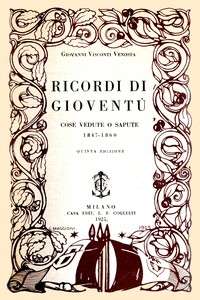
Ricordi di gioventù : Cose vedute o sapute - 1847-1860 by Visconti Venosta
(3 User reviews)
617
Visconti Venosta, Giovanni, 1831-1906
Italian
"Ricordi di gioventù : Cose vedute o sapute - 1847-1860" by Visconti Venosta is a historical memoir written in the early 20th century. It recounts the author’s youth and political awakening in Lombardy and the Valtellina across the turbulent years surrounding the Italian Risorgimento, blending family portraits with eyewitness glimpses of civic life...
moved from quiet habits to open resistance. The focus is on lived experience rather than formal history, filtered through an educated Milanese eye. The opening of the memoir frames the narrative as a letter to the author’s nephews, explaining his aim to record what he saw and heard from his childhood through the upheavals that led toward Italian unification. He evokes a loving household, profiling his learned, just father and his witty, compassionate mother, then looks back to a great‑grandfather tied to the Grisons’ rule and a grandfather active in late‑18th‑century Valtellina politics. He contrasts pre‑1848 Milanese customs with later changes, recalls the cholera scare and the imperial procession, and relates early school years at the Boselli institute (the ingenious maestro Pozzi, severe discipline, and classmates), alongside his father’s at‑home lessons and summers in Valtellina. He sketches his father’s scholarly work, contacts with Cesare Correnti and other patriots, and a coach accident that harmed his father’s eyesight, followed by a stormy excursion that preceded his father’s sudden death in 1846. The narrative then shifts to 1847: studies at home, Correnti’s mentorship, fervent readings (Berchet foremost, with Mazzini’s ideas circulating), the rising civic mood marked by Confalonieri’s funeral, a vast women‑led charity drive, and enthusiasm for Pius IX. It culminates in the fraught arrival of Archbishop Romilli, mass illuminations, clashes with police, and the first casualties in Milan, alongside provincial campaigning—hymns, slogans on walls—in the Valtellina; local companions, including the Vienna‑schooled Giacomo Merizzi, enter the scene as the agitation spreads. (This is an automatically generated summary.)
📢 Free to Use
This digital edition is based on a public domain text. You can copy, modify, and distribute it freely.
Edward Wilson
2 years agoSolid story.
Patricia Young
1 year agoAfter finishing this book, the storytelling feels authentic and emotionally grounded. Worth every second.
There are no comments for this eBook.



Michelle Smith
2 years agoWithout a doubt, the character development leaves a lasting impact. I couldn't put it down.