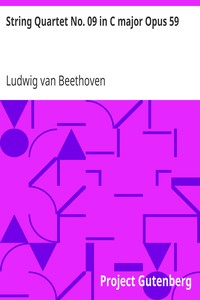
String Quartet No. 09 in C major Opus 59 by Ludwig van Beethoven

(10 User reviews)   3462
By Abil Kile Posted on Nov 15, 2025
In Category - Romance
Beethoven, Ludwig van, 1770-1827 Beethoven, Ludwig van, 1770-1827
English
Hey, you know how we sometimes think of Beethoven as the guy who wrote those stormy, dramatic symphonies? This string quartet is the exact opposite, and it's mind-blowing. It's like he decided to build a cathedral out of sunlight. Written during a really tough time in his life, it’s shockingly optimistic and full of grace. The main 'conflict' isn't a battle—it's the quiet, persistent struggle to find joy and order when everything feels chaotic. It's Beethoven telling us, 'Look, I hear the darkness too, but listen to this beautiful thing instead.' Trust me, put it on during your next quiet afternoon. It changes the air in the room.
Share

Read "String Quartet No. 09 in C major Opus 59 by Ludwig van Beethoven" Online

This book is available in the public domain. Start reading the digital edition below.

START READING FULL BOOK
Instant Access    Mobile Friendly

Book Preview

A short preview of the book’s content is shown below to give you an idea of its style and themes.

large fortune in the world as there are pretty women to deserve them. Miss Ward, at the end of half a dozen years, found herself obliged to be attached to the Rev. Mr. Norris, a friend of her brother-in-law, with scarcely any private fortune, and Miss Frances fared yet worse. Miss Ward’s match, indeed, when it came to the point, was not contemptible: Sir Thomas being happily able to give his friend an income in the living of Mansfield; and Mr. and Mrs. Norris began their career of conjugal felicity with very little less than a thousand a year. But Miss Frances married, in the common phrase, to disoblige her family, and by fixing on a lieutenant of marines, without education, fortune, or connexions, did it very thoroughly. She could hardly have made a more untoward choice. Sir Thomas Bertram had interest, which, from principle as well as pride—from a general wish of doing right, and a desire of seeing all that were connected with him in situations of respectability, he would have been glad to exert for the advantage of Lady Bertram’s sister; but her husband’s profession was such as no interest could reach; and before he had time to devise any other method of assisting them, an absolute breach between the sisters had taken place. It was the natural result of the conduct of each party, and such as a very imprudent marriage almost always produces. To save herself from useless remonstrance, Mrs. Price never wrote to her family on the subject till actually married. Lady Bertram, who was a woman of very tranquil feelings, and a temper remarkably easy and indolent, would have contented herself with merely giving up her sister, and thinking no more of the matter; but Mrs. Norris had a spirit of activity, which could not be satisfied till she had written a long and angry letter to Fanny, to point out the folly of her conduct, and threaten her with all its possible ill consequences. Mrs. Price, in her turn, was injured and angry; and an answer, which comprehended each sister in its bitterness, and bestowed such very disrespectful reflections on the pride of Sir Thomas as Mrs. Norris could not possibly keep to herself, put an end to all intercourse between them for a considerable period. Their homes were so distant, and the circles in which they moved so distinct, as almost to preclude the means of ever hearing of each other’s existence during the eleven following years, or, at least, to make it very wonderful to Sir Thomas that Mrs. Norris should ever have it in her power to tell them, as she now and then did, in an angry voice, that Fanny had got another child. By the end of eleven years, however, Mrs. Price could no longer afford to cherish pride or resentment, or to lose one connexion that might possibly assist her. A large and still increasing family, an husband disabled for active service, but not the less equal to company and good liquor, and a very small income to supply their wants, made her eager to regain the friends she had so carelessly sacrificed; and she addressed Lady Bertram in a letter which spoke so much contrition and despondence, such a superfluity of children, and such a want of almost everything else, as could not but dispose them all to a reconciliation. She was preparing for her ninth lying-in; and after bewailing the circumstance, and imploring their countenance as sponsors to the expected child, she could not conceal how important she felt they might be to the...

This is a limited preview. Download the book to read the full content.

Okay, let's be clear: this isn't a book with chapters and characters. But if you listen to it like a story, it unfolds beautifully. String Quartet No. 9 is part of a set Beethoven wrote for a Russian count. Forget the brooding genius stereotype for a minute. Here, he's building something spacious, confident, and often downright cheerful.

The Story

The first movement feels like a grand, welcoming argument between four friends (the violin, viola, and two cellos), all agreeing to build something magnificent together. The second movement is a deep, slow prayer—this is where you might feel a lump in your throat. Then, he throws in a surprisingly brisk and delicate third movement before launching into a final section that’s pure, clever energy. It’s a journey from grand statement, through heartfelt reflection, and out into a playful, brilliant finish.

Why You Should Listen

What gets me is the context. Beethoven was grappling with his worsening deafness around this time. The fact that he could channel his energy into music this generous and structurally perfect feels like an act of defiance. He’s not ignoring the struggle; he’s answering it with overwhelming creativity and clarity. It’s less about raw emotion and more about the triumph of a brilliant mind organizing sound into pure beauty.

Final Verdict

Perfect for anyone who thinks classical music is stuffy or always sad. This is Beethoven at his most approachable and luminous. If you need a soundtrack for focused work, a deep think, or just a reset for your mood, this quartet is a powerful tool. It’s not a easy listen that fades into the background—it asks for your attention and rewards you with a sense of peace and intellectual wonder.


ℹ️ Copyright Free

The copyright for this book has expired, making it public property. Access is open to everyone around the world.

Nancy Scott
4 months ago

Surprisingly enough, the arguments are well-supported by credible references. Thanks for sharing this review.

Brian Lee
1 year ago

Having read this twice, the pacing is just right, keeping you engaged. Thanks for sharing this review.

Thomas Anderson
7 months ago

Honestly, the clarity of the writing makes this accessible. A valuable addition to my collection.

Steven Allen
1 year ago

Very interesting perspective.

Noah Taylor
1 year ago

If you enjoy this genre, the author's voice is distinct and makes complex topics easy to digest. Exceeded all my expectations.
4.5
4.5 out of 5 (10 User reviews )

Add a Review

Your Rating *
There are no comments for this eBook.
You must log in to post a comment.
Log in


Related eBooks