
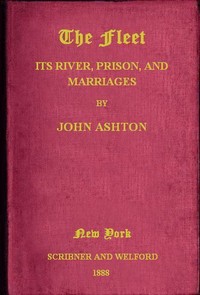
The Fleet: Its Rivers, Prison, and Marriages by John Ashton

(4 User reviews)   2537
By Abil Kile Posted on Nov 15, 2025
In Category - History
Ashton, John, 1834-1911 Ashton, John, 1834-1911
English
Hey, I just read this wild book about London's most notorious debtors' prison, the Fleet. It's not your typical dry history. The author, John Ashton, pulls back the curtain on a whole secret society that existed right in the city's heart. We're talking about a place where people were locked up for owing money, but within its walls, they ran their own shops, taverns, and even a thriving black market for illegal weddings. The central mystery isn't a 'whodunit' but a 'how-could-this-happen?' How did this bizarre, almost self-governing prison-world function for centuries? It's a fascinating look at a forgotten slice of London life that feels stranger than fiction.
Share

Read "The Fleet: Its Rivers, Prison, and Marriages by John Ashton" Online

This book is available in the public domain. Start reading the digital edition below.

START READING FULL BOOK
Instant Access    Mobile Friendly

Book Preview

A short preview of the book’s content is shown below to give you an idea of its style and themes.

further course is kept in our memory by Brook Street, Hanover Square. The name of this little river has exercised many minds, and has been the cause of spoiling much good paper. My own opinion, backed by many antiquaries, is that a _Fleet_ means a brook, or tributary to a larger river, which is so wide, and deep, at its junction with the greater stream as to be navigable for the small craft then in use, for some little distance. Thus, we have the names on the Thames of Purfleet, Northfleet, and Southfleet, and the same obtains in other places. Its derivation seems to be Saxon--at least, for our language. Thus, in Bosworth's "Dictionary of the Anglo-Saxon Language," we find, "Flede-Fledu: part. _Flooded_; _overflowed_: tumidus[2]: Tiber fledu wearð[3]--the Tiber was flooded (Ors. 4. 7)." Again, the same author gives: "Fleot (_Plat_ fleet, m. _a small river_; _Ger._ flethe. f. _a channel_). _A place where vessels float_, _a bay_, _gulf_, _an arm of the sea_, _the mouth of a river_, _a river_; hence the names of places, as _Northfleet_, _Southfleet_, _Kent_; and in London, _Fleet ditch_; _sinus_.[4] Soes Fleot, _a bay of the sea_.[5] _Bd._ 1. 34." Another great Anglo-Saxon scholar--Professor Skeat, in "An Etymological Dictionary of the English Language": "Fleet, a creek, bay. In the names _North-fleet_, _Fleet_ Street, &c. Fleet Street was so named from the Fleet Ditch; and _fleet_ was given to any shallow creek, or stream, or channel of water. See Halliwell. M.E. _fleet_ (Promptorium Parvulorum, &c., p. 166). A.S. _fleót_, a bay of the sea, as in Soes Fleot, bay of the sea. Ælfred's tr. of Beda, i. 34.[5] Afterwards applied to any channel or stream, especially if shallow. The original sense was 'a place where vessels float,' and the derivation is from the old verb _fleet_, to float, &c." The French, too, have a cognate term, especially in Norman towns, as Barfleur, Honfleur, Harfleur, &c., which were originally written Barbe_flot_, Hune_flot_, and Hare_flot_: and these were sometimes written Hareflou, Huneflou, and Barfleu, which latter comes very near to the Latin _flevus_, called by Ptolemy _fleus_, and by Mela _fletio_. Again, in Brittany many names end in _pleu_, or _plou_, which seems to be very much like the Greek [Greek: pleô]: _full_, _swollen_, which corresponds to our Anglo-Saxon Flede; Dutch Vliet. But it has another, and a very pretty name, "THE RIVER OF WELLS," from the number of small tributaries that helped to swell its stream, and from the wells which bordered its course; such as Sadler's Wells, Bagnigge Wells, White Conduit, Coldbath, Lamb's Conduit, Clerkenwell--all of which (although all were not known by those names in Stow's times) were in existence. Stow, in his "SURVEY OF LONDON" (ed. 1603, his last edition, and which consequently has his best corrections), says-- [Sidenote: "_Riuer of Wels._] [Sidenote: _Decay of the Riuer of the Wels._] [Sidenote: _Parliament Record._] [Sidenote: _Riuer of Wels bare ships._] [Sidenote: Patent Record. _Mils by Baynards Castel, made in the first of King John._] [Sidenote: _Turnemill Brooke._] That the riuer of Wels in the west parte of the Citty, was of olde so called of the Wels, it may be proued thus, William the Conqueror in his Charter to the Colledge of S. Marten le Grand in London, hath these wordes: I doe giue and graunt to the same Church all the land and the Moore, without the Posterne, which is called Cripplegate, on eyther part of the Postern, that is to say, from the North corner of the Wall, as the riuer of the Wels, there neare running, departeth the same More from...

This is a limited preview. Download the book to read the full content.

John Ashton's The Fleet isn't a novel with a single plot, but a deep dive into the incredible true story of London's Fleet Prison. For centuries, this was where debtors were sent. But instead of a simple lock-up, the Fleet became a chaotic, bustling mini-city within London's walls.

The Story

Ashton walks us through the prison's grim routines and its shocking freedoms. Inmates could have their families live with them, run businesses from their cells, and even leave during the day if they promised to return. The most infamous part? The "Fleet Marriages." For decades, shady priests performed quick, cheap, and often secret weddings right in the prison taverns, no questions asked. The book follows the rise and chaotic fall of this entire system, showing how corruption and a unique set of rules created a world utterly apart from the London outside.

Why You Should Read It

What hooked me was the sheer human drama. This isn't just about laws and dates. It's about the clever, desperate, and sometimes downright crooked people—both prisoners and jailers—who built this strange economy. You meet characters who turned imprisonment into an opportunity and see how society's failure to deal with debt created a monster of its own. It makes you think about justice, freedom, and how systems can twist into something unrecognizable.

Final Verdict

Perfect for anyone who loves offbeat history, true crime adjacent stories, or vivid social history. If you enjoy books that show you the weird, everyday realities of the past—the smells, the scams, the struggles—you'll be glued to this. It's a compelling portrait of an institution that was, in its own messy way, a world unto itself.


🏛️ Free to Use

Legal analysis indicates this work is in the public domain. It is available for public use and education.

Patricia Hernandez
1 month ago

My professor recommended this, and I see why.

Linda Lopez
4 months ago

Just what I was looking for.

Mark Anderson
1 year ago

Great read!

Thomas Taylor
3 months ago

This is one of those stories where the character development leaves a lasting impact. I will read more from this author.


4.5
4.5 out of 5 (4 User reviews )

Add a Review

Your Rating *
There are no comments for this eBook.
You must log in to post a comment.
Log in


Related eBooks