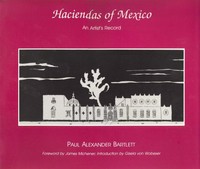
The Haciendas of Mexico: An Artist's Record by Paul Alexander Bartlett

(6 User reviews)   2544
By Abil Kile Posted on Nov 15, 2025
In Category - History
Bartlett, Paul Alexander, 1909-1990 Bartlett, Paul Alexander, 1909-1990
English
Ever wonder what happened to those grand old Mexican estates you might see in photos? 'The Haciendas of Mexico' is not your typical history book. It's a haunting, beautiful goodbye letter written by an artist who spent years traveling the country, sketching and painting these fading giants before they vanished. The book is filled with his detailed drawings and thoughtful words. It feels like you're right there with him, walking through crumbling courtyards and empty halls, trying to piece together the stories of the families who lived there and the workers who kept them running. It's a quiet, powerful look at how history gets lost, and what we can try to save before it's too late.
Share

Read "The Haciendas of Mexico: An Artist's Record by Paul Alexander Bartlett" Online

This book is available in the public domain. Start reading the digital edition below.

START READING FULL BOOK
Instant Access    Mobile Friendly

Book Preview

A short preview of the book’s content is shown below to give you an idea of its style and themes.

that I wrote to the architect-artist to inform him of my pleasure. Subsequently, I saw examples of his devotion to the great haciendas with their strong Mexican-Spanish coloration, and always I enjoyed his reminders of what life in colonial Mexico must have been like for the favored classes. It is rewarding to renew my acquaintance with this remarkable body of work, for it is a reassuring example of what a lifetime of scholarship can accomplish. +Preface+ The haciendas of Mexico have a special appeal for me. They represent a way of life that is now gone--some would say fortunately, since it was often a burdensome and cruel way of life for the peasant workers, a way of life that eventually motivated a revolution and the dissolution of the majority of hacienda landholdings. Many haciendas can be reached only with difficulty by horse or by foot, by boat or motorcycle or jeep. Their isolation from the culture of Europe, three hundred years ago, impresses the mind with its severity. In their isolation, these estates recall the brave attempts of hacienda families to re-establish cultivated patterns of living in the New World, with fine china and crystal, grand pianos and chapel organs, ornate furnishings, paintings, and tapestries. For my project, I received no financial rewards. Hence, I made repeated trips to Mexico, each funded by the modest savings accumulated in the United States between visits, with the hacienda project ever in mind. My wife, Elizabeth encouraged my efforts. She was my mainstay, my constant friend and faithful companion. Our son, Steven, was born in Mexico and was raised in a world punctuated by hacienda visits; he was my _compañero_ on many hacienda trips. The three of us usually returned to Mexico to stay for a year or two at a time. To find out where haciendas were located in a particular area, I turned to local government officials, owners of village stores, the postman, or the peasant who delivered charcoal on his burro. Mostly, I found the haciendas on random trips, when their archways and rooftops appeared in the distance. In 1941, when I began this project, few studies of the Mexican hacienda had been made. Only a handful of scholars had visited individual haciendas, and had gained first-hand familiarity with a limited number of them. To this day, with the possible exception of my own work, this is still true. And it is certain to remain true, since many of the haciendas I visited no longer exist. My own interest in that heritage was to re-create the special aura that my visits to more than three hundred haciendas had created. As an artist I felt an enduring affinity with a time that is no more, a heritage and tradition that may be recaptured only, I think, through the medium of art. This, then, is an attempt to survey the story of the haciendas. It is not a treatise about their economic structure, their political influence, or their historical importance in the establishment of New Spain. Despite the meager records relating to the many individual haciendas, there are excellent studies of regional haciendas in Mexico. The reader will find references to them in the Bibliography. The text was written to accompany a selection of my hacienda illustrations, including descriptions of hacienda life based on information received from personal contacts with hacienda families and caretakers who could still recall the old days. My impressions and commentary are offered to enable the reader to leave the twentieth century for a while and return to a period when the freshly colonized American continent witnessed the...

This is a limited preview. Download the book to read the full content.

This book is a special kind of treasure hunt. Paul Alexander Bartlett wasn't just a writer; he was an artist with a mission. For years, he traveled across Mexico, seeking out the old haciendas—the vast, often crumbling estates that were once the heart of the country's agricultural and social life. The story here is simple: it's his journey to capture them before they were gone forever.

The Story

There's no fictional plot, but there's a clear narrative. It's the story of Bartlett's quest. He shows up at these remote, sometimes forgotten places with his sketchpad and paints. He meets caretakers, listens to local memories, and carefully draws what he sees: grand archways, weathered walls, and silent chapels. The book is built around these beautiful illustrations, each one paired with his observations about the hacienda's history, architecture, and the quiet atmosphere of its present-day decay. The 'conflict' is time itself, slowly erasing these landmarks.

Why You Should Read It

What makes this book so engaging is its personal touch. You feel Bartlett's respect and his sense of urgency. It's not a dry list of facts. It's one man's effort to hold onto something beautiful and historically important. The drawings are incredible—full of detail and feeling. They make you stop and really look at the craftsmanship of a stone fountain or the pattern of light in a courtyard. It makes you think about all the everyday history that disappears without a record.

Final Verdict

This is a perfect book for anyone who loves art, history, or travel from their armchair. If you enjoy quiet, reflective books that focus on place and memory, you'll be captivated. It's also a fantastic pick for artists or architects looking for inspiration. Think of it less as a textbook and more as a beautifully illustrated travel journal from a lost world. It's a gentle, poignant reminder to look a little closer at the old places around us.


⚖️ Legal Disclaimer

This text is dedicated to the public domain. Share knowledge freely with the world.

Emma Moore
4 months ago

After hearing about this author multiple times, the author's voice is distinct and makes complex topics easy to digest. Exactly what I needed.

David Flores
1 year ago

Not bad at all.

Liam Johnson
1 year ago

I started reading out of curiosity and it challenges the reader's perspective in an intellectual way. Exceeded all my expectations.

Linda Hill
2 months ago

I stumbled upon this title and it creates a vivid world that you simply do not want to leave. Don't hesitate to start reading.

Liam Lopez
1 year ago

From the very first page, the narrative structure is incredibly compelling. I couldn't put it down.

5
5 out of 5 (6 User reviews )

Add a Review

Your Rating *
There are no comments for this eBook.
You must log in to post a comment.
Log in


Related eBooks