
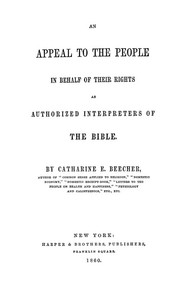
An Appeal to the People in Behalf of Their Rights as Authorized Interpreters of…

(0 User reviews)   1353
By Abil Kile Posted on Nov 15, 2025
In Category - Neval
Beecher, Catharine Esther, 1800-1878 Beecher, Catharine Esther, 1800-1878
English
Hey, have you ever read something that makes you realize how much we take for granted? I just finished this 1846 book by Catharine Beecher, and it's wild. It's not a novel—it's a fiery argument about who gets to interpret the Bible. Back then, only trained male clergy held that power. Beecher, a woman writing in a man's world, makes a radical case: that ordinary people, especially women and mothers, have the right and the responsibility to read and understand scripture for themselves and their families. It's a short read, but it feels incredibly modern. It's about intellectual freedom, challenging authority, and the quiet power of everyday people to shape belief. It made me think about who controls the narratives in our own lives today.
Share

Read "An Appeal to the People in Behalf of Their Rights as Authorized Interpreters of…" Online

This book is available in the public domain. Start reading the digital edition below.

START READING FULL BOOK
Instant Access    Mobile Friendly

Book Preview

A short preview of the book’s content is shown below to give you an idea of its style and themes.

Chapter III. Questions Connected with the Augustinian Theory. Chapter IV. The Difficulties Involved in the Augustinian Theory. Chapter V. The Augustinian Theory in Creeds. Chapter VI. Modes of Meeting Difficulties by Theologians. Chapter VII. Theologians Themselves Concede the Augustinian Dogmas Indefensible. Chapter VIII. The Augustinian Theory Contrary to the Moral Sense of Mankind. Chapter IX. The Principles of Common Sense Defined. Chapter X. Common Sense Applied to Gain the Existence of God. Chapter XI. The People’s Mental Philosophy. Chapter XII. The Nature of Mind, or Its Powers and Faculties. Chapter XIII. Nature of Mind.—Regulation of the Thoughts. Chapter XIV. Nature of Mind.—The Moral Sense, or Moral Susceptibilities. Chapter XV. The Nature of Mind.—The Will. Chapter XVI. Constitutional Varieties of the Human Mind. Chapter XVII. Nature of Mind.—Habit. Chapter XVIII. The Nature of Mind Our Guide to the Natural Attributes of God. Chapter XIX. The Nature of Mind Our Guide to the Moral Attributes of God. Chapter XX. Additional Proof of the Moral Attributes of God. Chapter XXI. Nature of Mind as Perfect in Construction. Chapter XXII. Right and Wrong—True Virtue. Chapter XXIII. Laws and Penalties—Sin and Holiness. Chapter XXIV. Love to God And Love to Man. Chapter XXV. Increased Civilization Increases Moral Difficulties. Chapter XXVI. Humility and Meekness. Chapter XXVII. The Standard of Right and Wrong Decided by The Risks of Eternity. Chapter XXVIII. The Destiny of Man in the Future Life. Chapter XXIX. What Must We Do To Be Saved? Chapter XXX. How Far Reason and Experience are Sufficient Without Revelation. Chapter XXXI. Augustinian Creeds and Theologians Teach the Common‐Sense System. Chapter XXXII. Augustinian Creeds and Theologians Contradict the Common‐ Sense System, and Thus, Also, Contradict Themselves. Chapter XXXIII. The Augustinian Theory Not In The Bible. Chapter XXXIV. A Reliable Revelation From The Creator Impossible If It Contains The Augustinian Theory. Chapter XXXV. Tendencies of the Two Opposing Systems. Chapter XXXVI. Tendencies of the Two Systems As They Respect the Cultivation of the Moral and Intellectual Powers. Chapter XXXVII. Tendencies of the Two Systems in Respect to Individual Religious Experience. Chapter XXXVIII. Tendencies of the Two Systems in Reference to the Character of God. Chapter XXXIX. Tendencies of the Two Systems as to Church Organizations. Chapter XL. Tendencies of the Two Systems in Regard to Humility, Meekness and a Teachable Spirit. Chapter XLI. Tendencies of the Two Systems in Regard to Dogmatism, Persecution and Ecclesiastical Tyranny. Chapter XLII. Tendencies of the Two Systems as Shown in Controversy and Sects. Chapter XLIII. Practical Tendencies of the Two Systems. Chapter XLIV. Tendencies of the Two Systems in the Training of Children. Chapter XLV. The People Rejecting the Augustinian System.—Position of Theologians. Chapter XLVI. Present Position of the Church. Chapter XLVII. State of the Pastors of Churches. Chapter XLVIII. The Position of Popular Education. Chapter XLIX. The Position of Woman as Chief Educator of Mind. Chapter L. Present Position of Young America. Chapter LI. Present Position of the Religious Press. Chapter LII. The Present Position of the Secular Press. Chapter LIII. What The People Will Do? Note. Notes. Footnotes [Cover Art] TO The Editors of the Secular Press, THE TRUE TRIBUNES OF THE PEOPLE, CALLED OF GOD IN BEHALF OF THE COMMONWEALTH TO DEFEND LIBERTY OF CONSCIENCE, FREEDOM OF SPEECH, AND THE RIGHT OF ALL TO INTERPRET THE BIBLE FOR THEMSELVES, UNRESTRAINED BY ANY ECCLESIASTICAL POWER, THIS VOLUME IS RESPECTFULLY DEDICATED. CHAPTER I. INTRODUCTION. There is an obvious crisis approaching, in the religious world, on questions of the highest moment. In past time such periods of change have been preceded by a slow and silent preparation, in which multitudes have been led...

This is a limited preview. Download the book to read the full content.

This isn't a story in the traditional sense. It's a passionate essay, a direct appeal to the public written in 1846. The central 'plot' is Beecher's argument against the exclusive authority of the clergy. She believed that limiting biblical interpretation to a professional class created a dangerous power imbalance and kept people, particularly women, from developing their own spiritual and moral understanding.

The Story

Imagine a time when your local minister was the sole expert on the most important book in your community. Catharine Beecher steps into this world and says, 'Wait a minute.' She builds a careful, logical case. She argues that the ability to read and reason is a gift from God, meant for everyone. She positions mothers as the first and most crucial moral teachers, who must be equipped with this knowledge. The 'conflict' is between established institutional authority and the individual's right to think for themselves.

Why You Should Read It

What struck me was how personal it feels. This isn't dry theology. You can hear Beecher's voice—firm, intelligent, and urgent. She's not trying to overthrow religion; she's trying to bring it home, literally. Her focus on the family and education as the bedrock of society feels surprisingly relevant. Reading it, you get a front-row seat to a quiet revolution in thinking, led by a woman using reason and faith as her tools.

Final Verdict

Perfect for anyone interested in the history of ideas, women's history, or American religion. It's a quick but powerful look at a foundational debate about authority and access to knowledge. If you've ever wondered how everyday people began to claim their own voice in matters of faith and conscience, this book is a fascinating and accessible starting point.


📢 Open Access

There are no legal restrictions on this material. It is available for public use and education.

There are no reviews for this eBook.

0
0 out of 5 (0 User reviews )

Add a Review

Your Rating *
There are no comments for this eBook.
You must log in to post a comment.
Log in


Related eBooks