La Política de los Estados Unidos en el Continente Americano by Cárdenas y Echarte

(3 User reviews)   2096
By Abil Kile Posted on Dec 30, 2025
In Category - Neval
Cárdenas y Echarte, Raúl de, 1884-1979 Cárdenas y Echarte, Raúl de, 1884-1979
Spanish
Ever wonder how the US really became the dominant power in the Americas? Forget the simple story you learned in school. This book pulls back the curtain on a century of calculated moves, from the Monroe Doctrine to military interventions, showing how the US built its 'backyard.' It’s a fascinating, and sometimes uncomfortable, look at the real politics behind the headlines, written from a perspective we don’t often get to hear. If you think you know the history of US-Latin American relations, this might just change your mind.
Share

Read "La Política de los Estados Unidos en el Continente Americano by Cárdenas y Echarte" Online

This book is available in the public domain. Start reading the digital edition below.

START READING FULL BOOK
Instant Access    Mobile Friendly

Book Preview

A short preview of the book’s content is shown below to give you an idea of its style and themes.

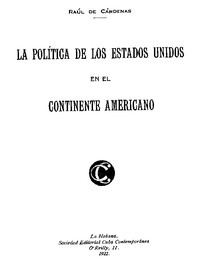
Imprenta El Siglo XX. de la Sociedad Editorial Cuba Contemporánea. Teniente Rey 27, La Habana. BIBLIOTECA "LA CULTURA CUBANA" VOL. III RAÚL DE CÁRDENAS LA POLÍTICA DE LOS ESTADOS UNIDOS EN EL CONTINENTE AMERICANO [Ilustración] La Habana. Sociedad Editorial Cuba Contemporánea O'Reilly, 11. 1921. _A mis amigos, los Doctores Antonio S. de Bustamante y Cosme de la Torriente; en testimonio de afecto y admiración._ ÍNDICE PRIMERA PARTE LA EXPANSIÓN TERRITORIAL Págs. I. _La ocupación de territorios contiguos._ (A) (1783) Área comprendida entre los montes Alleghanies y el río Mississippi 1 (B) (1803) Louisiana 9 (C) (1819) Florida 22 (D) (1845) Tejas 28 (E) (1848) Alta California y Nuevo Méjico 45 (F) (1846) Oregon 50 (G) (1854) El valle de Mesilla 57 II. _La adquisición de territorios distantes._ (A) (1867) Alaska 58 (B) (1898) Haway 60 (C) (1898) Puerto Rico, las Filipinas y Guam 75 (D) (1899) Tutuila 80 (E) (1816) Las Antillas danesas 81 III. _Notas críticas acerca del movimiento expansionista._ 83 SEGUNDA PARTE LA DOCTRINA DE MONROE I. _Su antecedente: la política del "aislamiento" o de "las dos esferas_". 89 II. _Sus orígenes._ 93 III. _Relación de los casos en que ha sido aplicada._ 105 Afirmaciones positivas 106 Afirmaciones negativas 106 IV. _Notas críticas._ Verdadera significación de la Doctrina de Monroe 174 Contribuyó a darle popularidad y fuerza, la circunstancia de que defendiera el principio del gobierno propio 176 El mantenimiento de la Doctrina de Monroe es siempre de actualidad para los Estados Unidos 177 Sobre los casos en que ha sido infringida la Doctrina de Monroe 179 Fué en un tiempo de carácter "presidencial" exclusivamente, pero hoy es también "congresional" 181 La Doctrina de Monroe y el Derecho Internacional 181 La Doctrina de Monroe en los actuales momentos 184 TERCERA PARTE LA PREPONDERANCIA EN EL CARIBE I. (A) Cuba 187 (B) Panamá 212 (C) Santo Domingo 231 (D) Haití 246 (E) Nicaragua 253 (F) Costa Rica 260 (G) Guatemala 262 (H) Méjico 263 II. _Notas críticas._ I. La política intervencionista de los Estados Unidos en el mar Caribe. Sus precursores. Sus causas. Caracteres que le son propios 269 II. La ingerencia norteamericana en las Repúblicas de Cuba, Panamá, Santo Domingo, Haití y Nicaragua, a tenor de los tratados vigentes y en la práctica. Censuras de que ha sido objeto 275 III. El factor económico en las relaciones de los Estados Unidos con las Repúblicas que se encuentran bajo su esfera de influencia 282 IV. Ingerencia de la Administración del Presidente Wilson en determinados asuntos, de orden interno, de las Repúblicas de Méjico, Costa Rica y Guatemala 283 PRIMERA PARTE LA EXPANSIÓN TERRITORIAL I LA OCUPACIÓN DE TERRITORIOS CONTIGUOS (A) (1783) ÁREA COMPRENDIDA ENTRE LOS MONTES ALLEGHANIES Y EL RÍO MISSISSIPPI. A principios del siglo XVIII, el extenso territorio que hoy ocupa la República norteamericana formaba tres distintas colonias: una española, otra francesa y otra inglesa. Esta última ocupaba un área muy reducida en proporción a las otras dos. No era más que una faja de territorio que corría desde el río Penobscot, en Maine, hasta el cabo Romano en la Carolina del Sur, y desde el Atlántico hasta la cordillera de los Alleghanies. Sin embargo, con el andar de los tiempos, la colonia inglesa primero, los Estados Unidos después, uniendo la acción social a la política, lograron terminar con las dominaciones europeas y agregaron a su territorio el área inmensa de sus colonias. Comenzó la expansión de los Estados Unidos antes de que los norteamericanos alcanzaran la independencia. Esta manifestación, aparentemente paradójica, no lo es. Los primeros pasos del proceso expansionista se dieron a principios del siglo XVIII...

This is a limited preview. Download the book to read the full content.

Raúl de Cárdenas y Echarte wasn't just an observer; he was a Cuban diplomat who lived through the era he writes about. His book isn't a dry list of dates. Instead, he connects the dots between big ideas and real-world actions. He shows how policies like 'Manifest Destiny' and the Roosevelt Corollary weren't just speeches—they were blueprints for political and economic control that reshaped entire nations.

The Story

The book walks us through the 19th and early 20th centuries, focusing on key moments where US power was projected south. It covers the Spanish-American War, the creation of the Panama Canal, and the frequent military interventions in Central America and the Caribbean. Cárdenas frames this not as random events, but as a consistent strategy to secure US interests, often at the expense of Latin American sovereignty. The central thread is the tension between the US's stated ideals of democracy and freedom and its practical actions on the ground.

Why You Should Read It

What makes this book stick with you is the perspective. It’s a view from within the hemisphere, written with the insight of someone who understood the diplomatic chessboard. It challenges the simplistic 'good guy' narrative and makes you think about the long-term consequences of foreign policy. It’s not an anti-American rant; it’s a critical analysis that asks tough questions about power and its uses.

Final Verdict

This is a must-read for anyone interested in the real history of the Americas, not just the US version. It's perfect for history buffs, political science students, or anyone who enjoys books that make them see current events in a new light. Be prepared for a detailed, thoughtful read that doesn't shy away from complexity. It’s a classic for a reason.


🏛️ Public Domain Content

You are viewing a work that belongs to the global public domain. You do not need permission to reproduce this work.

Barbara Taylor
10 months ago

To be perfectly clear, the atmosphere created is totally immersive. Don't hesitate to start reading.

Daniel Harris
1 year ago

As someone who reads a lot, the storytelling feels authentic and emotionally grounded. Thanks for sharing this review.

Donald Smith
1 year ago

Five stars!

5
5 out of 5 (3 User reviews )

Add a Review

Your Rating *
There are no comments for this eBook.
You must log in to post a comment.
Log in


Related eBooks