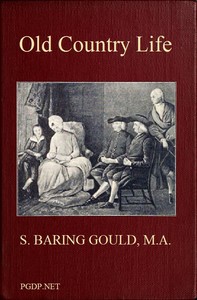
Old Country Life by S. Baring-Gould

(3 User reviews)   1334
By Abil Kile Posted on Nov 15, 2025
In Category - Neval
Baring-Gould, S. (Sabine), 1834-1924 Baring-Gould, S. (Sabine), 1834-1924
English
Hey, have you ever wondered what life was really like in the English countryside before cars and electricity? 'Old Country Life' isn't a novel—it's a time machine. Written by a Victorian parson who lived it, this book is a collection of memories and observations that feel like sitting down with your great-grandfather by the fire. He tells you about the old squires and farmers, the village festivals that have vanished, and the superstitions people truly believed in. It’s not about a single mystery, but the bigger puzzle of how we lost a whole world of tradition and community. If you've ever felt a pang of nostalgia for a time you never knew, this book explains where that feeling comes from.
Share

Read "Old Country Life by S. Baring-Gould" Online

This book is available in the public domain. Start reading the digital edition below.

START READING FULL BOOK
Instant Access    Mobile Friendly

Book Preview

A short preview of the book’s content is shown below to give you an idea of its style and themes.

Europe and upset existing conditions social as well as political. Napoleon overran Germany, and the nobles and gentry had not recovered their losses during that terrible period before the State took advantage of their condition to transfer the land to the peasantry. This was not done everywhere, but it was so to a large extent in the south. Money was advanced to the farmers to buy out their landlords, and the impoverished nobility were in most cases glad to sell. They disposed of the bulk of their land, retaining in some cases the ancestral nest, and that only. No doubt that the results were good in one way--but where is a good unmixed? The qualifying evil is considerable in this case. The gentry or nobility--the terms are the same on the Continent--went to live in the towns. They could no longer afford to inhabit their country mansions. They acquired a taste for town life, its conveniences, its distractions, its amusements; they ceased to feel interest in country pursuits; they only visited their mansions for about eight weeks in the year, for the _Sommer-frische_. Those who could not afford to furnish two houses, carted that amount of furniture which was absolutely necessary to their country houses for the holiday, and that concluded, carted it back to town again. This state of things continues. Whilst the family is in residence at the Schloss it lives economically; it is there for a little holiday; it does not concern itself with the peasants, the sick, the suffering, the necessitous. It is there--_pour s'amuser_. The consequence is that the Schloss is without a civilizing influence, without moral force in the place. The country folk have little interest in the family, and the family concerns itself less with the people. Not only so, but it brings little money into the place. It employs no labour. It is there not to keep open house, but to shut up the purse. In former days the landlord exacted his rents, but then he lived in the midst of his tenants, and the money that came in as rent went out as wage, and in payment for butter, eggs, meat, oats, and hay. The money collected out of a place returned to it again. It is so in many country places in England now where squire and parson live on the land. In Germany the peasant has stepped out of obligation to the landlord into bondage to the Jew, who receives, but spends nothing. In France the condition is much the same; the great house is a ruin, and so, very generally, is the family that occupies and owns it, if it still lingers on in it. I remember a stately château of the time of Louis XIV., tenanted by two charming old ladies of the _ancienne noblesse_, with grand historic names--the last leaves that fluttered on a great family tree, with roots in the remote past; and they fluttered sere to their fall. They walked out every evening in the park attended by their factotum, an old serving-man, who was butler, coachman, gardener, and major-domo. They kept but one female servant, who was cook, lady's-maid, laundress, and house-maid. The old ladies are dead now, and the roof of the château has fallen in. They had no money to spend on the house or in the village, and never was there a village that more needed the circulation in it of a little coin. Great houses, with us, are only tenanted by their owners when the London season is over; but that is for a good deal longer than the...

This is a limited preview. Download the book to read the full content.

Forget dry history books. 'Old Country Life' is something much better: a guided tour of rural England in the 1800s, led by someone who had one foot in the old ways and the other in the modern age. Sabine Baring-Gould was a country parson, folk song collector, and novelist who watched the old traditions fade as railways and industry changed everything. This book is his personal scrapbook of that vanishing world.

The Story

There isn't a single plot. Instead, think of it as a series of vivid snapshots. One chapter might describe the boisterous, sometimes rowdy, Harvest Home feast. Another explains the intricate, almost forgotten rules of 'tenant right' for farmers. He writes about traveling peddlers, ghost stories locals swore by, and the distinct character of the old country squire. It’s not a straight timeline, but a rich collection of the textures, sounds, and social rules of a pre-industrial England.

Why You Should Read It

What makes this book special is the author's voice. Baring-Gould isn't a distant scholar; he's a local telling you stories. You can feel his affection for these people and their ways, even when he finds their superstitions amusing. Reading it, you get a real sense of the rhythm of life tied to the land and the seasons—a rhythm most of us have completely lost. It’s surprisingly cozy and fascinating at the same time.

Final Verdict

Perfect for anyone who loves shows like 'The Victorian Farm' or gets lost in local history museums. It's a must-read for genealogy buffs wanting to understand their ancestors' daily lives. If you enjoy nature writing or simply crave a quiet, thoughtful escape from the modern world, this book is a charming and insightful companion. Just don't expect a thriller—the drama here is in the quiet details of lives lived differently.


🏛️ Legacy Content

This masterpiece is free from copyright limitations. It is now common property for all to enjoy.

Thomas Wright
1 year ago

After hearing about this author multiple times, the content flows smoothly from one chapter to the next. I couldn't put it down.

Richard Young
1 year ago

Recommended.

Ethan Torres
1 year ago

Enjoyed every page.

4
4 out of 5 (3 User reviews )

Add a Review

Your Rating *
There are no comments for this eBook.
You must log in to post a comment.
Log in


Related eBooks