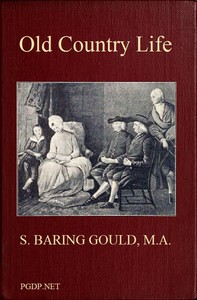
Old Country Life by S. Baring-Gould

(7 User reviews)   2450
By Abil Kile Posted on Nov 15, 2025
In Category - Adventure
Baring-Gould, S. (Sabine), 1834-1924 Baring-Gould, S. (Sabine), 1834-1924
English
Ever wonder what life was really like in the English countryside a hundred years ago? Forget the romantic novels—'Old Country Life' by S. Baring-Gould is your time machine. This isn't a stuffy history book; it's a collection of stories and observations from a man who lived it. He writes about the real people: the farmers, the blacksmiths, the old wives with their superstitions, and the ghosts they swore haunted the moors. The main mystery isn't a single crime, but the slow, quiet disappearance of a whole way of life. Gould captures it all just before it vanished. If you've ever walked an old footpath and felt the echoes of the past, you need to read this.
Share

Read "Old Country Life by S. Baring-Gould" Online

This book is available in the public domain. Start reading the digital edition below.

START READING FULL BOOK
Instant Access    Mobile Friendly

Book Preview

A short preview of the book’s content is shown below to give you an idea of its style and themes.

Europe and upset existing conditions social as well as political. Napoleon overran Germany, and the nobles and gentry had not recovered their losses during that terrible period before the State took advantage of their condition to transfer the land to the peasantry. This was not done everywhere, but it was so to a large extent in the south. Money was advanced to the farmers to buy out their landlords, and the impoverished nobility were in most cases glad to sell. They disposed of the bulk of their land, retaining in some cases the ancestral nest, and that only. No doubt that the results were good in one way--but where is a good unmixed? The qualifying evil is considerable in this case. The gentry or nobility--the terms are the same on the Continent--went to live in the towns. They could no longer afford to inhabit their country mansions. They acquired a taste for town life, its conveniences, its distractions, its amusements; they ceased to feel interest in country pursuits; they only visited their mansions for about eight weeks in the year, for the _Sommer-frische_. Those who could not afford to furnish two houses, carted that amount of furniture which was absolutely necessary to their country houses for the holiday, and that concluded, carted it back to town again. This state of things continues. Whilst the family is in residence at the Schloss it lives economically; it is there for a little holiday; it does not concern itself with the peasants, the sick, the suffering, the necessitous. It is there--_pour s'amuser_. The consequence is that the Schloss is without a civilizing influence, without moral force in the place. The country folk have little interest in the family, and the family concerns itself less with the people. Not only so, but it brings little money into the place. It employs no labour. It is there not to keep open house, but to shut up the purse. In former days the landlord exacted his rents, but then he lived in the midst of his tenants, and the money that came in as rent went out as wage, and in payment for butter, eggs, meat, oats, and hay. The money collected out of a place returned to it again. It is so in many country places in England now where squire and parson live on the land. In Germany the peasant has stepped out of obligation to the landlord into bondage to the Jew, who receives, but spends nothing. In France the condition is much the same; the great house is a ruin, and so, very generally, is the family that occupies and owns it, if it still lingers on in it. I remember a stately château of the time of Louis XIV., tenanted by two charming old ladies of the _ancienne noblesse_, with grand historic names--the last leaves that fluttered on a great family tree, with roots in the remote past; and they fluttered sere to their fall. They walked out every evening in the park attended by their factotum, an old serving-man, who was butler, coachman, gardener, and major-domo. They kept but one female servant, who was cook, lady's-maid, laundress, and house-maid. The old ladies are dead now, and the roof of the château has fallen in. They had no money to spend on the house or in the village, and never was there a village that more needed the circulation in it of a little coin. Great houses, with us, are only tenanted by their owners when the London season is over; but that is for a good deal longer than the...

This is a limited preview. Download the book to read the full content.

Sabine Baring-Gould wasn't just an observer of 19th-century rural England; he was a part of it. As a clergyman and squire living on the wild edges of Dartmoor, he had a front-row seat to a world that was changing fast. Old Country Life is his personal record of that world.

The Story

There isn't a single plot. Think of it as a series of vivid snapshots. Gould takes you inside the smoky kitchens of old farmhouses, out to the fields during harvest, and along lonely lanes at dusk. He introduces you to the characters who defined the countryside: the cunning poacher, the wise village carpenter, the storytellers who kept ancient legends alive. He explains old customs, from wassailing apple trees to peculiar funeral rites, and isn't afraid to share the darker local tales of pixies, witchcraft, and restless spirits. The book follows the rhythm of the seasons and the unbroken cycle of rural life.

Why You Should Read It

What makes this book special is Gould's voice. He's not a distant academic; he's a curious neighbor with a fantastic memory. His writing is warm, sometimes funny, and full of genuine affection for the people and traditions he describes. You get the sense he's rushing to write it all down before the new railways and modern ideas make it all forgotten. Reading it feels like sitting by a fire and listening to your most interesting relative tell stories about 'the old days.' It adds layers of meaning to every old stone wall, country pub, and regional folk song you might encounter.

Final Verdict

Perfect for anyone who loves social history, folklore, or simply a good, atmospheric read. If you enjoy the works of Thomas Hardy or miss the vibe of shows like All Creatures Great and Small, this is your book. It's a slow, charming, and deeply human look at a vanished England, written by someone who knew it intimately. Keep a cup of tea handy.


🏛️ Public Domain Content

The copyright for this book has expired, making it public property. It serves as a testament to our shared literary heritage.

Mark Flores
1 year ago

The formatting on this digital edition is flawless.

Logan Brown
2 months ago

If you enjoy this genre, the character development leaves a lasting impact. I couldn't put it down.


5
5 out of 5 (7 User reviews )

Add a Review

Your Rating *
There are no comments for this eBook.
You must log in to post a comment.
Log in


Related eBooks