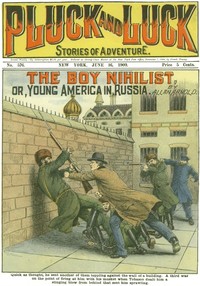
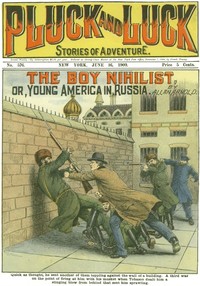
The boy nihilist : or, Young America in Russia by Allan Arnold

(5 User reviews)   2592
By Abil Kile Posted on Nov 15, 2025
In Category - Neval
Arnold, Allan Arnold, Allan
English
Ever wonder what would happen if a cynical young American found himself stuck in Russia during one of its most turbulent times? That's exactly what happens in this forgotten gem from 1903. Our hero, a self-proclaimed 'nihilist' who doesn't believe in much of anything, gets shipped off to Moscow. He expects to be bored, but instead gets tangled in political plots, secret societies, and a romance that challenges everything he thinks he knows. It's part fish-out-of-water comedy, part political thriller, and a fascinating window into how Americans saw Russia over a century ago. If you like historical fiction with a sharp, sarcastic edge, this one's a real find.
Share

Read "The boy nihilist : or, Young America in Russia by Allan Arnold" Online

This book is available in the public domain. Start reading the digital edition below.

START READING FULL BOOK
Instant Access    Mobile Friendly

Book Preview

A short preview of the book’s content is shown below to give you an idea of its style and themes.

PROFESSOR OF MATHEMATICS AND ASTRONOMY IN THE UNIVERSITY OF MISSISSIPPI. NEW YORK: PUBLISHED BY CARLTON & PHILLIPS. 200 MULBERRY STREET. 1854. CONTENTS Introduction. Of The Possibility Of A Theodicy. Section I. The failure of Plato and other ancient philosophers to construct a Theodicy, not a ground of despair. Section II. The failure of Leibnitz not a ground of despair. Section III. The system of the moral universe not purposely involved in obscurity to teach us a lesson of humility. Section IV. The littleness of the human mind a ground of hope. Section V. The construction of a Theodicy, not an attempt to solve mysteries, but to dissipate absurdities. Section VI. The spirit in which the following work has been prosecuted, and the relation of the author to other systems. Part I. The Existence Of Moral Evil, Or Sin, Consistent With The Holiness Of God. Chapter I. The Scheme Of Necessity Denies That Man Is Responsible For The Existence Of Sin. Section I. The attempts of Calvin and Luther to reconcile the scheme of necessity with the responsibility of man. Section II. The manner in which Hobbes, Collins, and others, endeavour to reconcile necessity with free and accountable agency. Section III. The sentiments of Descartes, Spinoza, and Malebranche, concerning the relation between liberty and necessity. Section IV. The views of Locke, Tucker, Hartley, Priestley, Helvetius, and Diderot, with respect to the relation between liberty and necessity. Section V. The manner in which Leibnitz endeavours to reconcile liberty and necessity. Section VI. The attempt of Edwards to establish free and accountable agency on the basis of necessity—The views of the younger Edwards, Day, Chalmers, Dick, D’Aubigne, Hill, Shaw, and M’Cosh, concerning the agreement of liberty and necessity. Section VII. The sentiments of Hume, Brown, Comte, and Mill, in relation to the antagonism between liberty and necessity. Section VIII. The views of Kant and Sir William Hamilton in relation to the antagonism between liberty and necessity. Section IX. The notion of Lord Kames and Sir James Mackintosh on the same subject. Section X. The conclusion of Mœhler, Tholuck, and others, that all speculation on such a subject must be vain and fruitless. Section XI. The true conclusion from the foregoing review of opinions and arguments. Chapter II. The Scheme Of Necessity Makes God The Author Of Sin. Section I. The attempts of Calvin and other reformers to show that the system of necessity does not make God the author of sin. Section II. The attempt of Leibnitz to show that the scheme of necessity does not make God the author of sin. Section III. The maxims adopted and employed by Edwards to show that the scheme of necessity does not make God the author of sin. Section IV. The attempts of Dr. Emmons and Dr. Chalmers to reconcile the scheme of necessity with the purity of God. Chapter III. Scheme Of Necessity Denies The Reality Of Moral Distinctions. Section I. The views of Spinoza in relation to the reality of moral distinctions. Section II. The attempt of Edwards to reconcile the scheme of necessity with the reality of moral distinctions. Section III. Of the proposition that "The essence of the virtue and vice of dispositions of the heart and acts of the will, lies not in their cause, but in their nature." Section IV. The scheme of necessity seems to be inconsistent with the reality of moral distinctions, not because we confound natural and moral necessity, but because it is really inconsistent therewith. Chapter IV. The Moral World Not Constituted According To The Scheme Of Necessity. Section I. The scheme of necessity is...

This is a limited preview. Download the book to read the full content.

I stumbled across this old book almost by accident, and I'm so glad I did. Published in 1903, it’s a wild ride that feels surprisingly modern in its attitude.

The Story

We follow a young, disillusioned American man who calls himself a nihilist—meaning he’s pretty sure all big ideas and governments are pointless. His family, hoping to straighten him out, sends him to work for an uncle in Moscow. He expects dusty museums and dull tea parties. What he finds is a city buzzing with underground political movements. He’s quickly pulled into a world of coded messages, risky meetings, and a growing attraction to a fierce young woman who actually believes in changing the world. His cynical shell starts to crack as he has to figure out what, if anything, is worth fighting for.

Why You Should Read It

First, the main character is hilarious. His sarcastic commentary on everything from Russian bureaucracy to his own family is sharp and funny. But the real magic is watching his journey from apathy to engagement. The book isn't a dry history lesson; it's a personal story about finding your place in a messy world. It also offers a captivating snapshot of a pivotal moment, showing the simmering tensions in Russia long before the 1917 revolution, all through the eyes of a skeptical outsider.

Final Verdict

This is a perfect pick for readers who love character-driven historical fiction with a good dose of wit. If you enjoyed the cynical charm of a character like The Sun Also Rises' Jake Barnes but wished he’d gotten mixed up in a pre-revolution spy novel, this is your next read. It’s a short, punchy, and utterly unique look at a time and place we don’t often see in fiction, led by a narrator you won’t forget.


⚖️ Public Domain Content

This text is dedicated to the public domain. It is now common property for all to enjoy.

David Wilson
5 months ago

This book was worth my time since the narrative structure is incredibly compelling. Don't hesitate to start reading.

Betty Jackson
8 months ago

I was skeptical at first, but the storytelling feels authentic and emotionally grounded. Exactly what I needed.

Ashley Lee
1 year ago

Based on the summary, I decided to read it and the emotional weight of the story is balanced perfectly. Don't hesitate to start reading.

Edward Torres
1 year ago

If you enjoy this genre, it manages to explain difficult concepts in plain English. I couldn't put it down.

Margaret Sanchez
4 months ago

This book was worth my time since it creates a vivid world that you simply do not want to leave. Worth every second.
5
5 out of 5 (5 User reviews )

Add a Review

Your Rating *
There are no comments for this eBook.
You must log in to post a comment.
Log in


Related eBooks