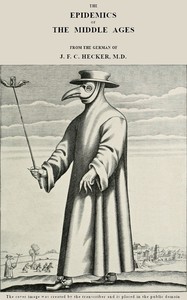
The Epidemics of the Middle Ages by J. F. C. Hecker and John Caius

(4 User reviews)   2079
By Abil Kile Posted on Dec 30, 2025
In Category - Neval
Caius, John, 1510-1573 Caius, John, 1510-1573
English
Ever wonder what it was really like to live through a medieval plague? Forget dry history textbooks. This book throws you right into the chaos. It's a time machine back to the 16th century, written by a doctor, John Caius, who was actually there, watching the 'Sweating Sickness' tear through London. He wasn't just observing from a distance; he was in the thick of it, trying to understand a disease that could kill a healthy person in hours. The main mystery? What was this terrifying illness, and why did it vanish as suddenly as it appeared? It's a gripping, first-hand account of medical terror and human resilience.
Share

Read "The Epidemics of the Middle Ages by J. F. C. Hecker and John Caius" Online

This book is available in the public domain. Start reading the digital edition below.

START READING FULL BOOK
Instant Access    Mobile Friendly

Book Preview

A short preview of the book’s content is shown below to give you an idea of its style and themes.

medical historian, and one of the most able medical writers in Germany. His numerous works suffice to show not only with what zeal he has laboured, but also how highly his labours have been appreciated by his countrymen; and when I state that, with one trifling exception, they have all been translated into other languages, I furnish a fair proof of the estimation in which they are held in foreign countries; and, so far at least as regards the originals, a full justification of the Council of the Sydenham Society in their choice on the present occasion. The “Schwarze Tod,” or “Black Death,” was published in 1832; and I was prompted to undertake its translation, from a belief that it would prove interesting at a moment when another fearful epidemic, the Cholera, with which it admitted of comparison in several particulars, was fresh in the memory of men. The “Tanzwuth,” or “Dancing Mania,” came out shortly afterwards; and, as it appeared to me that, though relating to a less terrific visitation, it possessed an equal share of interest, and, holding a kind of middle place between a physical and a moral pestilence, furnished subject of contemplation for the general as well as the professional reader, I determined on adding it also to our common stock of medical literature. When the “Englische Schweiss,” or “Sweating Sickness,” which contained much collateral matter little known in England, and which completed the history of the principal epidemics of the middle ages, appeared in 1834, I proceeded to finish my task; but failing in the accomplishment of certain arrangements connected with its publication, I laid aside my translation for the time under a hope, which has at length been fulfilled, that at some future more auspicious moment, it might yet see the light. It must not be supposed that the author, in thus taking up the history of three of the most important epidemics of the middle ages, although he has illustrated them by less detailed notices of several others, considers that he has exhausted his subject; on the contrary, it is his belief, that, in order to come at the secret springs of these general morbific influences, a most minute as well as a most extended survey of them, such as can be made only by the united efforts of many, is required. He would seem to aim at collecting together such a number of facts from the medical history of all countries and of all ages, as may at length enable us to deal with epidemics in the same way as Louis has dealt with individual diseases; and thus by a numerical arrangement of data, together with a just consideration of their relative value, to arrive at the discovery of general laws. The present work, therefore, is but one stone of an edifice, for the construction of which he invites medical men in all parts of the world to furnish materials[1]. Whether the information which could be collected even by the most diligent and extensive research would prove sufficiently copious and accurate to enable us to pursue this method with complete success, may be a matter of doubt; but it is at least probable, that many valuable facts, now buried in oblivion, would thus be brought to light; and the incidental results, as often occurs in the pursuit of science, might prove as serviceable as those which were the direct object of discovery. Of what immense importance, for instance, in the fourteenth century, would a general knowledge have been of the simple but universal circumstance, that in all severe epidemics, from the time...

This is a limited preview. Download the book to read the full content.

This isn't a novel with a traditional plot. Instead, it's a collection of historical medical writings. The core of the book is John Caius's own 1552 pamphlet, 'A Boke or Counseill Against the Disease Commonly Called the Sweate, or Sweatyng Sicknesse.' Caius, a founding fellow of what would become Gonville and Caius College, Cambridge, and a royal physician, wrote this as a practical guide during an outbreak. He describes the sickness's sudden onset, its brutal symptoms (violent sweats, fever, pain), and its frightening speed. He also records his observations on who seemed most at risk and his thoughts on treatment, giving us a raw, unfiltered look at medicine before germs were understood.

Why You Should Read It

Reading Caius's account is haunting. You feel his frustration and urgency. He's trying to fight a shadow enemy with the limited tools of his time. It makes our modern health anxieties feel connected to a much longer human story. The value here is the perspective. You're not getting a historian's analysis written centuries later; you're getting the voice of a smart, terrified, and dedicated man in the middle of the crisis. It's a powerful reminder of how people have always grappled with the unknown.

Final Verdict

Perfect for anyone fascinated by the history of medicine, pandemics, or everyday life in the Tudor era. If you enjoyed the visceral feel of books about more recent outbreaks, this is the original source material. It's a short, intense read that packs a real punch. Just be prepared—it's not a light escape. It's a window into a world where a headache at breakfast could mean you were dead by dinner.


⚖️ Community Domain

No rights are reserved for this publication. It is now common property for all to enjoy.

Kevin Clark
5 months ago

After finishing this book, the content flows smoothly from one chapter to the next. A valuable addition to my collection.

Matthew Wright
3 months ago

To be perfectly clear, the content flows smoothly from one chapter to the next. I will read more from this author.

Liam Nguyen
1 year ago

Honestly, the author's voice is distinct and makes complex topics easy to digest. One of the best books I've read this year.

John Nguyen
1 year ago

Citation worthy content.

5
5 out of 5 (4 User reviews )

Add a Review

Your Rating *
There are no comments for this eBook.
You must log in to post a comment.
Log in


Related eBooks