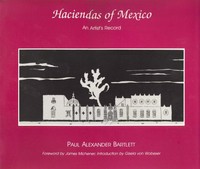
The Haciendas of Mexico: An Artist's Record by Paul Alexander Bartlett

(4 User reviews)   2481
By Abil Kile Posted on Nov 15, 2025
In Category - Neval
Bartlett, Paul Alexander, 1909-1990 Bartlett, Paul Alexander, 1909-1990
English
Picture this: you're flipping through a friend's travel sketchbook, but instead of quick doodles, you find detailed portraits of forgotten giants. That's what Paul Alexander Bartlett gives us in 'The Haciendas of Mexico.' It's not just a book of art; it's a rescue mission. Bartlett spent years tracking down the crumbling, beautiful estates that shaped Mexico's history. Through his drawings and words, he captures these places right before many of them vanished or were changed forever. He's saving ghosts on paper. If you love art, history, or stories about places with deep secrets, this quiet, powerful book will pull you in. It feels like being let in on a beautiful, urgent secret.
Share

Read "The Haciendas of Mexico: An Artist's Record by Paul Alexander Bartlett" Online

This book is available in the public domain. Start reading the digital edition below.

START READING FULL BOOK
Instant Access    Mobile Friendly

Book Preview

A short preview of the book’s content is shown below to give you an idea of its style and themes.

that I wrote to the architect-artist to inform him of my pleasure. Subsequently, I saw examples of his devotion to the great haciendas with their strong Mexican-Spanish coloration, and always I enjoyed his reminders of what life in colonial Mexico must have been like for the favored classes. It is rewarding to renew my acquaintance with this remarkable body of work, for it is a reassuring example of what a lifetime of scholarship can accomplish. +Preface+ The haciendas of Mexico have a special appeal for me. They represent a way of life that is now gone--some would say fortunately, since it was often a burdensome and cruel way of life for the peasant workers, a way of life that eventually motivated a revolution and the dissolution of the majority of hacienda landholdings. Many haciendas can be reached only with difficulty by horse or by foot, by boat or motorcycle or jeep. Their isolation from the culture of Europe, three hundred years ago, impresses the mind with its severity. In their isolation, these estates recall the brave attempts of hacienda families to re-establish cultivated patterns of living in the New World, with fine china and crystal, grand pianos and chapel organs, ornate furnishings, paintings, and tapestries. For my project, I received no financial rewards. Hence, I made repeated trips to Mexico, each funded by the modest savings accumulated in the United States between visits, with the hacienda project ever in mind. My wife, Elizabeth encouraged my efforts. She was my mainstay, my constant friend and faithful companion. Our son, Steven, was born in Mexico and was raised in a world punctuated by hacienda visits; he was my _compañero_ on many hacienda trips. The three of us usually returned to Mexico to stay for a year or two at a time. To find out where haciendas were located in a particular area, I turned to local government officials, owners of village stores, the postman, or the peasant who delivered charcoal on his burro. Mostly, I found the haciendas on random trips, when their archways and rooftops appeared in the distance. In 1941, when I began this project, few studies of the Mexican hacienda had been made. Only a handful of scholars had visited individual haciendas, and had gained first-hand familiarity with a limited number of them. To this day, with the possible exception of my own work, this is still true. And it is certain to remain true, since many of the haciendas I visited no longer exist. My own interest in that heritage was to re-create the special aura that my visits to more than three hundred haciendas had created. As an artist I felt an enduring affinity with a time that is no more, a heritage and tradition that may be recaptured only, I think, through the medium of art. This, then, is an attempt to survey the story of the haciendas. It is not a treatise about their economic structure, their political influence, or their historical importance in the establishment of New Spain. Despite the meager records relating to the many individual haciendas, there are excellent studies of regional haciendas in Mexico. The reader will find references to them in the Bibliography. The text was written to accompany a selection of my hacienda illustrations, including descriptions of hacienda life based on information received from personal contacts with hacienda families and caretakers who could still recall the old days. My impressions and commentary are offered to enable the reader to leave the twentieth century for a while and return to a period when the freshly colonized American continent witnessed the...

This is a limited preview. Download the book to read the full content.

Paul Alexander Bartlett spent over a decade traveling across Mexico with a simple, massive goal: to find and document the country's historic haciendas. These were the vast agricultural and mining estates that were the backbone of colonial life, but by the mid-20th century, they were often abandoned, repurposed, or falling apart. This book is the stunning result of that quest.

The Story

There isn't a traditional plot with characters. Instead, the 'story' is Bartlett's journey itself. He visited hundreds of these sites, from grand palaces to simple farmhouses. With pencil, pen, and careful observation, he drew their arched doorways, weathered walls, and empty courtyards. He paired these illustrations with notes on their history, architecture, and the stories of the people who lived and worked there. The book is a visual and historical record, showing us the beauty and the decay of a fading way of life.

Why You Should Read It

This book is a quiet masterpiece of attention. Bartlett’s drawings have a respectful, almost loving detail. You can feel the sun on the adobe walls and the silence in the grand halls. It’s more than an architecture book. It makes you think about how history lives in places, and what happens when those places start to disappear. It’s a powerful reminder to look closely at the world around us, because things of beauty and importance might be quietly slipping away.

Final Verdict

Perfect for travelers-at-heart, history lovers who enjoy stories told through places, and anyone who appreciates beautiful, observational art. It’s not a fast-paced novel; it’s a book to savor. You’ll want to linger on each drawing, imagining the lives that filled these spaces. If you’ve ever felt a pang of nostalgia for a place you’ve never been, this book is for you.


🏛️ Legal Disclaimer

You are viewing a work that belongs to the global public domain. You can copy, modify, and distribute it freely.

Michael Sanchez
1 year ago

If you enjoy this genre, the arguments are well-supported by credible references. This story will stay with me.

Liam Harris
2 years ago

Based on the summary, I decided to read it and it creates a vivid world that you simply do not want to leave. Don't hesitate to start reading.

Joseph Clark
1 year ago

Based on the summary, I decided to read it and the arguments are well-supported by credible references. I learned so much from this.

Emily Walker
1 year ago

Wow.

4.5
4.5 out of 5 (4 User reviews )

Add a Review

Your Rating *
There are no comments for this eBook.
You must log in to post a comment.
Log in


Related eBooks