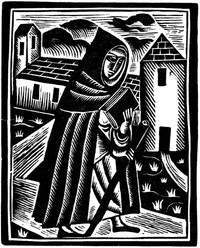
Wood Engraving by R. J. Beedham

(7 User reviews)   2907
By Abil Kile Posted on Nov 15, 2025
In Category - Adventure
Beedham, R. J., 1879-1975 Beedham, R. J., 1879-1975
English
Hey, I just finished this quiet little book about wood engraving from the 1920s, and it completely changed how I see the everyday art around me. It’s not a dry manual; it’s more like a master craftsman inviting you into his workshop. R.J. Beedham explains how he carves intricate stories into blocks of wood to create prints, turning a simple plank into a world of light, shadow, and texture. The real magic is how he makes you appreciate the patience and skill behind every line. If you've ever looked at an old book illustration or a print and wondered, 'How did they do that?' this is your answer. It’s a short, beautiful reminder of the human hand in art.
Share

Read "Wood Engraving by R. J. Beedham" Online

This book is available in the public domain. Start reading the digital edition below.

START READING FULL BOOK
Instant Access    Mobile Friendly

Book Preview

A short preview of the book’s content is shown below to give you an idea of its style and themes.

Wood-cut from The Decameron, Venice, 1492. Re-engraved by R. J. Beedham. By permission of The Shakespeare Head Press Alphabet, by Reynolds Stone _(By permission of Burns, Gates & Washbourne, Ltd.)_ _From_ Forrest Reid’s Apostate, by Reynolds Stone _(By permission of Faber & Faber, Ltd.)_ Winter, from a sketch by Verrall, by R. J. Beedham Strawberry Picking, by Claire Leighton _(By permission of Victor Gollancz)_ March, by Mrs. G. Raverat “Miss Jenkyns reading Rasselas,” by Joan Hassall _(By permission of George G. Harrap & Co., Ltd.)_ The Cottage, by Robert Gibbings INTRODUCTION TO SECOND EDITION This book is not a treatise upon the _art_ of wood-engraving. It is simply a description of the tools and materials required by a beginner and the method of using them. It is not intended to assist anyone to become a commercial engraver, for that trade requires a long and specialized training. It is intended rather for those who have occasion or opportunity or inclination to make illustrations or ornaments for books and who are revolted by the degradation to which the art of formal drawing has been brought by photographic “process” reproduction. The “line” block and the “half-tone” have one clear claim to usefulness: viz. when an exact facsimile is required. It is doubtful, however, whether process reproduction would have been developed very far if its use had been confined to those occasions, and those only, when exact facsimile was of vital importance. Process reproduction owes its success to its commercial possibilities more than to its real merits, for, in spite of the frequently reiterated boast of those engaged in business that nothing can be a commercial success that does not “supply a want,” by photographic reproduction a speed and cheapness have been obtained which have seduced both artists and the public. A “want” has certainly been supplied, but it is a want of quantity rather than of quality, and, as in all cases where quantitative ideas are the motive force, quality has inevitably deteriorated so that book production has become a mere business and with no criterion save that of a commercial success. It is of course impossible to stem the tide of commercial degradation until Poverty, Chastity, and Obedience take the place of Riches, Pleasure, and _Laisser-faire_ as personal and national ideals. Such a change of heart cannot occur merely as the result of economic or social or philosophical propaganda; the matter is more fundamental than that. The modern world is founded upon a denial of absolute values, a denial of religion, a denial of God; upon such denials nothing can be built. Goodness becomes what the police will allow or can enforce. Beauty becomes what pleases the senses and Truth becomes what will pay. Meanwhile it is possible for any individual that wills to do so to go out into the wilderness and to live and work in a manner more in harmony with the nature of man and the will of God. For it is in accord neither with the will of God nor the nature of man that any one should love himself more than his neighbour or his neighbour more than God. The present state of affairs is an unnatural and abnormal thing. It is a disease. And any one can by the grace of God cure at least himself and put his own affairs in order. In the domain of art the remedy is the same as in any other. The thing good in itself must be found and loved. Relative values must give place to absolute, the lovely and lovable to the beautiful. “Does it pay?” is...

This is a limited preview. Download the book to read the full content.

Forget everything you think you know about technical manuals. Wood Engraving by R.J. Beedham is a warm, personal guide from a true expert. First published in the 1920s, it walks you through the entire process of this precise art form, from choosing the right tools and wood to designing an image and pulling the final print.

The Story

There isn't a plot in the traditional sense. Instead, Beedham takes you on a journey from blank block to finished artwork. He starts with the basics—the special woods, the sharp gravers, the ink. He then shows you, step-by-step, how to carve a design in reverse, explaining how to create different textures and effects. It's the story of an idea being physically carved into existence. The book is filled with his own engravings as examples, so you can see exactly what he's talking about.

Why You Should Read It

What makes this book special is Beedham's voice. He writes with the calm confidence of someone who has spent a lifetime mastering his craft. You feel like you're sitting beside him, learning his secrets. It demystifies a complex art and makes it feel accessible. Even if you never pick up a graver, you'll start seeing the world differently—noticing the fine lines in illustrations and the incredible detail that can come from a simple piece of wood.

Final Verdict

This is a perfect little book for curious minds, artists, and anyone who loves the history of print. If you're a fan of book arts, illustration, or just beautiful old books, you'll find it fascinating. It’s a snapshot of a craftsman's knowledge, preserved in clear, friendly prose. A real hidden gem for a quiet afternoon.


📚 Public Domain Content

This masterpiece is free from copyright limitations. Access is open to everyone around the world.

Andrew Lopez
1 year ago

To be perfectly clear, the content flows smoothly from one chapter to the next. Worth every second.

Patricia Allen
5 months ago

After finishing this book, the storytelling feels authentic and emotionally grounded. Absolutely essential reading.


4.5
4.5 out of 5 (7 User reviews )

Add a Review

Your Rating *
There are no comments for this eBook.
You must log in to post a comment.
Log in


Related eBooks